


3/16/2020
Good day,
What an absolutely absurd week we just experienced. There are probably 30 days in an average person's life where he or she will remember exactly where they were, who they were with, and what was around them when a specific event happened. For example, people will always remember where they were when 9/11 happened or on a happier note, when their first kid was born, their wedding day, or first day on a new job. Last week maybe delivered three days like this in a span of four. Last Monday, the markets crashed because of the price war that Saudi Arabia decided to get into with Russia in the oil market and American stock exchanges were halted from trading just four minutes into the trading day. Tuesday was Tuesday. Then Wednesday evening the NBA spiraled out of control and ended up suspending its season in a matter of 45 minutes and the epicenter for why the NBA decided to suspend its season was Oklahoma City. The Thunder were seconds away from tipping off against the Utah Jazz in a battle for the 4-seed in the Western Conference when a member of OKC's medical staff sprinted onto the floor, had a quick chat with both head coaches and officials, and then every player immediately went into the locker room followed by the officials. No one knew what was going on exactly for a solid 30 minutes. Fans were inside the arena watching the halftime entertainment perform during the confusion because no one in the arena knew what to do. Then it was announced that the game had been postponed because Rudy Gobert, Jazz player, tested positive for coronavirus and the results came in right before tip-off. The NBA then quickly moved to suspend the rest of the season. Jazz and Thunder players had to remain in the locker rooms for quite some time. Thunder players were able to leave around 10:30 that night but Jazz players didn't leave the arena until well after midnight as they were all administered tests in the locker room. Results did not come back for the Jazz players until Thursday morning. Fellow Jazz star Donovan Mitchell was the only other member of the organization to test positive for coronavirus. Too add fuel to this fire, Mitchell practiced with his teammates at Del City High School in OKC on Tuesday afternoon. He did not know, nor did Gobert, that he had coronavirus at the time. Since then, the sports world quickly spiraled out of control as all college basketball tournaments and the Major League Soccer season were cancelled and suspended respectively. Move forward to Thursday morning and U.S. stocks reacted severely to the news from the NBA and President Trump's announcement that travel from Europe to the U.S. would be suspended for 30 days with the exception of travel from the U.K. to the U.S. because apparently the U.K. is not a part of Europe. That is science though and science is hard. The stock market had to be halted only six minutes into the trading day on Thursday morning and then proceeded to decline at break neck speeds after trading resumed after the 15 minute breather expired. Outside of the stock market world, pretty much every collegiate and professional sport was suspended for at least a month. There will be no March Madness this year. That is hard to fathom. Sports ranging from the Premier League in England to even E-Sports leagues have been suspended. You know things are bad when the only thing to do on DraftKings is bet on the Democratic Debate that took place on Sunday night (15th). Three days out of four last week will likely be remembered by quite a few people for the rest of their lives. March 2020 may end up going down in the history books with a "bloody March" type name or something. The good news is, at some point coronavirus fears will subside and things can start returning to "normal." The sell off in stocks does setup for a buying opportunity if you have time and money though. You could buy anything and everything in the stock market right now and probably be up quite a bit of money in 3-5 years once the global economy has a chance to cool off and re-balance. First and foremost, the world has to get through these trying times. That can be accomplished much easier if some vintage Spurs teamwork starts breaking out everywhere. Panic seems to be tangible right now but it will give way to calm again at some point. As the wise, fictional, and two-faced Harvey Dent said in The Dark Knight, "The night is darkest just before the dawn. And I promise you, the dawn is coming."
March 16, 2020
In the pride contest between Russia and Saudi Arabia, U.S. shale has the most to lose
Saudi Arabia went with its nuclear option after a failed OPEC+ meeting on March 8th and declared a price war on Russia. This decision was made after OPEC member countries, led by Saudi Arabia, and non-OPEC countries, led by Russia, failed to agree on reducing production in order to off-set the demand loss caused by coronavirus rampaging throughout the world. The idea was to further cut production by up to 1.5mmbpd collectively with the floor of cutting production by 500mbpd. Russia said no thanks. Then Saudi Arabian leadership started a price war. This all led to oil prices collapsing last week and recording its second worst single trading day on record last Monday (9th). The record holder is the day when the U.S. launched Operation Desert Storm on January 17, 1991. To provide a meaningless reference, the third oldest player on the Thunder is NBA journeyman Mike Muscala and he was born on July 1, 1991. The world has not realized a drop in oil prices like this in Mike Muscala's lifetime. Now he has been forced to suffer through watching WTI prices drop a whopping 25% on Monday (9th) and finish at $31.13/bbl. To provide yet another meaningless reference,

you could buy three of the weird fish hook looking dangly keychains to the left or you could buy one bbl of oil right now. One will turn your keychain into a fishing lure and will come in really handy when you are in a tight spot, hungry, and near a lake while the other will provide energy things. The Wall Street Journal (WSJ), kindly pointed out that "debt-addled companies" such as OKC based Chesapeake Energy (CHK) and oil-weighted Whiting Petroleum, not based in OKC, were already facing severe difficulties surviving in a world of $60/bbl oil and then Monday happened. Wall Street has been demanding E&Ps to spin off free cash flow and provide solid returns to investors instead of chugging along with the dogmatic paradigm of growing production and reserves at all cost, which is the only thing the industry has ever known. A similar plunged occurred in late 2014 for oil and gas prices but that was back when the Thunder still had two top 10 players on its team and banks were willing to help U.S. shale companies endure the downturn by providing funding via the issuance of equity or debt. Now? Things are different. Wall Street has started to turn its back on the industry over the past few years due to poor returns and does not seem overly thrilled to provide the same type of capital relief in 2020 that it did in 2014-15. Pioneer CEO Scott Sheffield said in an interview last Monday that:
Probably 50% of the public E&Ps will go bankrupt over the next two years.
No oil companies were spared from the carnage of Saudi's decision to produce at all costs. While Saudi Arabia has been focused on keeping prices stable by cutting production and always willing to cut more, they may have missed the bigger picture that Russia might have been gaming them into for the last 3+ years of their forced and strained marriage. There is a decent chance that Russia has been developing a strategy on how to recapture its market share that it has steadily lost to U.S. shale producers since they joined forces with OPEC and Saudi Arabia to cut production while Saudi Arabia has been distracted with IPO'ing Aramco and diversifying its economy. As a result, Russia might have figured out a way to pit Saudi Arabia against U.S. shale producers under the veil of Saudi Arabian leaders believing they were entering a price war with Russia. Saudi Arabia is now hellbent on taking Russia's market share in Asia because of Russia's refusal to cut production further. The Saudis are willing to max out its production capacity ASAP to make it happen. Russia isn't bluffing either and is willing to crank up production too. Russia claims it has enough reserves in their sovereign wealth funds to weather a low price environment for 6-10 years. The Saudis believe their low-cost production fields give them running room for quite some time. So which side will blink first? Most likely, it'll be U.S. shale producers according to Bjørnar Tonhaugen who is the head of oil markets at Rystad Energy:
If the Saudis don’t pull back in May or June, others will have to slash their prices too. Where is it curtailed first? Where it’s not economic to drill…and continue production—that’s U.S. shale.
In the end, Russia's goal may actually be to devastate U.S. shale producers and drive as many of those companies into bankruptcy as possible while riding out the low price storm for a couple years in order to see a brighter future for itself after the U.S. fallout. U.S. banks have already signaled an unwillingness to fund U.S. shale over the past few years (see graph below). If that holds true, then the biggest winner in all of this may end up being Russia, which is ironic because that is who the Saudi's are trying to destroy.

Not all OPEC members want a price war
Top Saudi Arabian leadership may have went full Lance Stephenson, but the rest of OPEC prefers to not see this price war get off the ground. Top Saudi and Russian leadership are bragging about how long each country can withstand a prolonged price war as both have been doing quite a bit of posturing. Pretty much everyone else involved in the production cuts over the last four years are wanting to pump the brakes on the price war. Algeria, Iraq and the United Arab Emirates all depend heavily on oil revenue to fund their governments and their countries overall. Per the International Monetary Fund, Algeria needs an oil price of $92/bbl, Iraq needs $59/bbl, and UAE needs $68/bbl in order to balance their state budgets. That is quite a ways off from the $28-$33/bbl that crude has dropped to after Saudi broke the news that it was never really friends with Russia in the first place. Algeria has been working to bring Russia and Saudi Arabia back together and turn them into "friends" again. Algeria's energy minister, who also holds OPEC's rotating presidency, Mohamed Arkab provided this update on how talks have been going:
Intense contacts and discussions have started since Monday between OPEC and non-OPEC members to find ways and means to restore balance and stability in the oil market.
Iraqi Oil Minister Thamir Ghadhban has also been making contact, and not the Rudy Gobert contact with his teammates kind of contact, with other OPEC members trying to find ways to halt the sharp decline in oil price. The UAE has discounted its main crude contract by 15% and plans to increase production by 1 mmbpd and capacity by the same amount. I don't think the UAE read Algeria and Iraq's memo about trying to arrest the crude price slide correctly. Like science, reading is hard I guess. Faith Birol, executive director of the International Energy Agency, provided a snapshot of how vital a healthy oil price is to countries like Iraq and Algeria:
In some of these countries, it will be almost impossible to finance essential areas like health or education. It could challenge the stability of those countries where oil is the nerve-center.
Backing desperate countries into a corner and making it feel like they have no say in their ability to sustain themselves seems like a match that could spark a conflict, maybe even a war. In the end, Saudi's myopic show of self-aggrandizing may end with dire consequences for their region of the world.
BOK Financial Corporation of Tulsa (BOK) gets hit with price war shrapnel
U.S. shale companies are not the only businesses getting crushed by the Saudi vs Russia price war. The collateral damage of driving oil prices to multi-year lows is effecting the banking sector as well. According to financial services firm Keefe, Bruyette, and Woods, the five banks that have the largest exposure to the oil and gas sector in their portfolios are based in three states: two are in Texas, one in Kansas, and two are in Oklahoma. One of the banks was BOK which is based in Tulsa. According to The Washington Post (WaPo), BOK is in the most "worrisome" position with energy loans equal to 108 percent of a capital measure called "tangible common equity." No one knows what that is unless you spend all your free time playing Sims Banking or something so below are a few high level explanations from investopedia.com:
Tangible common equity (TCE) is a measure of a company's physical capital, which is used to evaluate a financial institution's ability to deal with potential losses.
Measuring a company's TCE is particularly useful for evaluating companies that have large amounts of preferred stock, such as U.S. banks that received federal bailout money in the 2008 financial crisis.
The TCE ratio (TCE divided by tangible assets) is a measure of capital adequacy at a bank. The tangible common equity (TCE) ratio measures a firm's tangible common equity in terms of the firm's tangible assets.
BOK's executive vice president of getting people not to panic, Stacy Kymes, said not to worry though as:
Most of the bank’s borrowers are sufficiently hedged against this sort of falloff. And 42 percent are primarily in natural gas, which he doesn’t expect to suffer the same price hit.
Everything is fine until those hedges run out. Then everything is not fine once the hedges are over and the price war is still going. Not going to acknowledge that as a possibility right now though much like I never acknowledged the possibility of snake aka kevin durant leaving OKC to join a 73 win team that he had down 3-1 in the Western Conference Finals. We will also not acknowledge that the International Energy Agency (IEA) released an updated oil demand forecast on March 9th that called for year-over-year (2019 vs 2020) oil demand to decline for the first time since 2009. There will also be no acknowledgement of Robert McNally's, president and founder of the Rapidan Energy Group, statement of how:
This is the first time since 1930 and ’31 that a massive negative demand shock has coincided with a supply shock. It’s sort of like a black swan to simultaneous hurricane event.
Shale wells in the U.S. are actually resilient and prolific in terms of what each can produce and are economical in most price environments when viewed in a vacuum. However, shale wells produce most of its oil and/or gas in its first 18-24 months of existence and then kind of dilly dallies along like Uncle Ray Felton did in his last year in OKC when he tried to play more than 3 consecutive minutes. This drop off in production constantly forces shale companies to reinvest its cash earned from these wells and drill more wells which in the grand scheme of things equates to shale companies kind of just spinning their wheels unless oil and nat gas prices are roughly higher than $60/bbl and $2.50/mmbtu. Add all of these factors in and it could be a tough year or few ahead for U.S. shale companies, banks tied to shale producers, and the states that depend on oil and gas production to make up a significant portion of its government funding. However, U.S. based companies are generally amazingly resilient in the face of insurmountable obstacles. Most likely these issues will be figured out and probably create some new financial tools or processes along the way. As the saying goes that is originally credited to Greek philosopher Plato: Necessity is the mother of invention.
Joe Biden wins big again in Super Tuesday II primaries
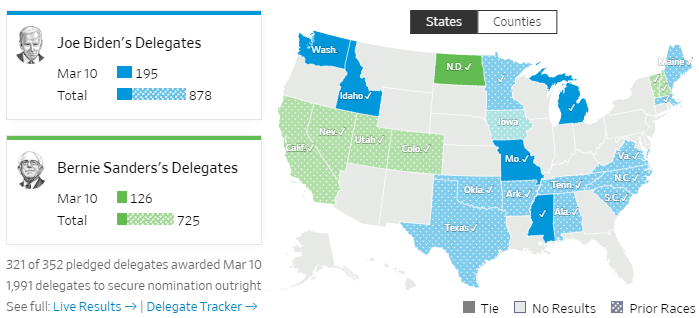
Sadly, this will be the only thing I can use the word "win" on over the next month or so thanks to coronavirus cancelling every sporting league on earth, basically. Joe Biden took a commanding lead after primaries took place in Michigan, Mississippi, Missouri, Idaho, North Dakota, and Washington state last Tuesday (10th). Biden ended up winning every state except for North Dakota although the delegates were split pretty evenly in Washington state and Idaho. On the night of Super Tuesday II, Biden began to pivot his speech towards expanding his umbrella to cover die-hard Bernie Sanders supporters as he said:
I want to thank Bernie Sanders and his supporters for their tireless energy and their passion. We share a common goal and, together, we’ll defeat Donald Trump; we’ll defeat him together.
What has seemed to provide so much momentum to Biden is the voters' view of him being the best candidate suited to defeat incumbent Donald Trump instead of voters casting their ballots for the candidate who best aligns with their viewpoints. It also helps that several prominent Democrats have endorsed Biden with U.S. Senator Kamala Harris and Cory Booker both backing him before Super Tuesday II. Both participated in a Detroit rally last Monday evening to provide a last minute boost to Biden's chances of winning Michigan and it paid off for him. Now Mr. Biden is squarely in the driver's seat to win the Democratic nomination for president. There was a belief that Sanders might end his campaign after Super Tuesday II, but he announced that he is going to stay in the race and plans on debating Biden in Phoenix on Sunday the 15th and he did. However, this debate has been moved to CNN's headquarters in Washington D.C. in order to "reduce cross-country travel during coronavirus concerns," according to the WSJ. Also, there is a great chance that campaign rallies will be substantially reduced and/or cancelled because of coronavirus concerns. The lack of an ability to hold rallies will likely be a greater detriment to Sanders moving forward than Biden. Sanders is skilled in holding massive rallies that are packed and have the appearance of creating momentum while that is definitely not Biden's forte. In the end though, it looks like Biden will definitely win the Democratic nomination and that Sanders is going to campaign for a bit longer in order to try and push the party a bit further left while he has an influential voice among voters. Updated delegate map via WSJ as of March 13th:
Carl Icahn gets jealous of how much attention coronavirus is getting; spends lots money
Ole rickety Icahn keeps forgetting that he's in a fight to take control of an oil and gas company. Every now and again he sees his post-it note reminder on his refrigerator that just says, "mad at Occidental. Try to take over the company," and then he goes out and buys a bigger stake in the embattled E&P. Icahn has never been happy with OXY's exec team after they decided to acquire Anadarko in what was basically one company taking over another company of the same size. It was reported by the WSJ last week that Icahn has upped his stake in OXY from 2.5% to 10% in his effort to take control of the company. That is quite the spike in ownership and has to leave CEO Vicki Hollub and her round table pretty nervous. Since the massive acquisition, OXY's market value has shrunk from $46B to less than $11B. The primary drivers behind the massive loss in value has been criticism about the total cost of the transaction and, more recently, how the sharp decline in oil and gas prices will further damage OXY's already strained balance sheet. Icahn had this golden nugget to say last week:
One thing I’ve learned in life is not to let people manage your affairs who are delusional enough to think they could outbid Chevron and outsmart Buffett. And yet this is just what the board has done, and it cost the shareholders $47 billion.
Icahn is seeking to gain his revenge by replacing all of OXY's board and Ms. Hollub. T. Rowe Price, another massive shareholder that holds a 14% stake in OXY, is beginning to side with Icahn. T. Rowe voted against Ms. Hollub and the company's other board member who were up for re-election during last year's annual shareholder meeting. However, Hollub and her board had enough support from other major shareholders to retain their positions. This year may not turn out so well for them. Icahn is pushing for OXY to put itself up for sale if he is not able to replace the entire board. His anger can be a bit understandable when considering that he has lost close to $1B on OXY so far, according to the WSJ. It seems more likely than not that Icahn will succeed in his quest for control of OXY this year, especially if he keeps reading that post-it note on his 'fridge everyday.
Thoughts of the week:
Currently, the Thunder have the 9th best record in the NBA. If the season ends up being cancelled, then OKC will lose one of its two first round draft picks in this year's draft to Philadelphia. OKC traded for Jerami Grant a few years ago and sent Philly a top-20 protected 2020 first round pick as compensation. This means if OKC finishes with a top 10 record in 2020, then it will send its first round pick to Philly. No good. First round picks are the best way for a market the size of OKC to build a legit title contender. With all this in mind, I think Sam Presti needs to get on the phone while he has nothing else to do and trade away a couple wins for losses so he can keep both first rounders. No one knows if that is legal or not but it's worth a shot.
Stay safe out there. Seems like we are all about to go into lock down for a bit.


Comments